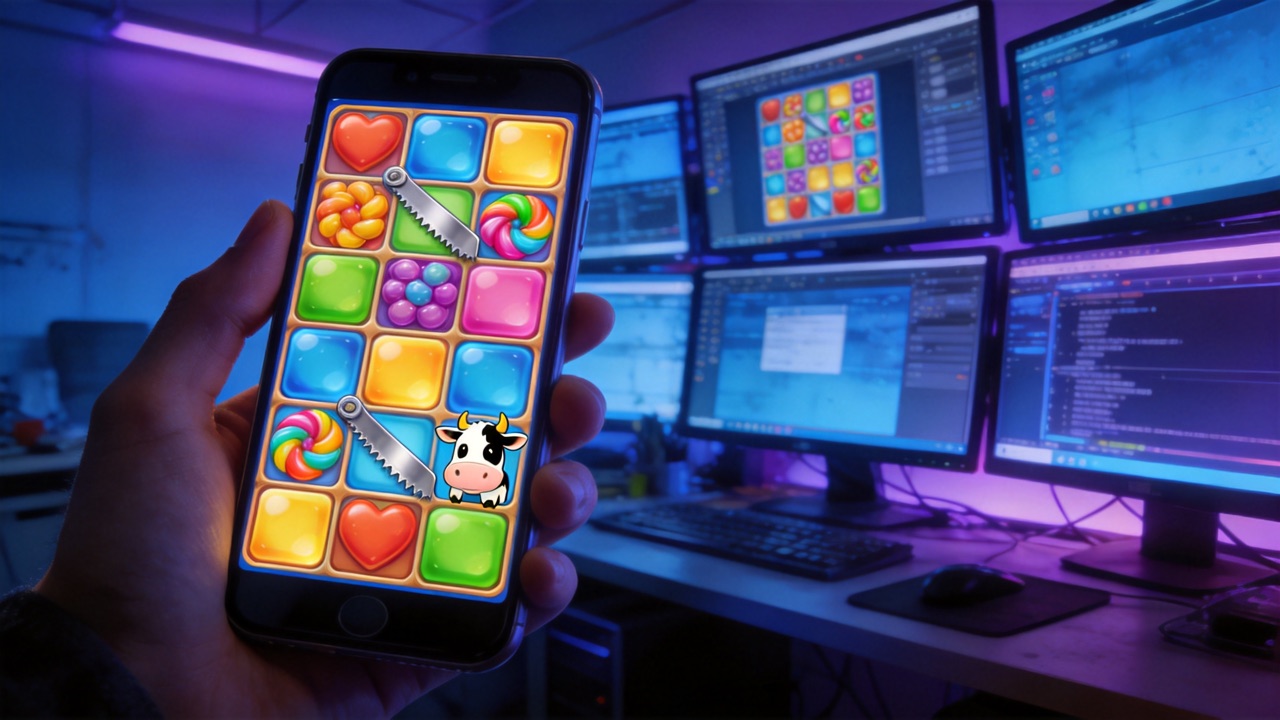
A cow pushed toward a saw blade. Award badges that were never awarded. A 60-second minigame sold as the product. The ASA ruled against all six ads this month, and the disclaimer "Not actual gameplay" did not save King — the regulator said the small print contradicted the ad rather than clarifying it. In the same week, AppMagic reported that mobile games stopped leading global in-app purchase revenue back in 2016. Together, the two stories describe one problem: the creative has become more valuable than the game.
一、 Six ads, four companies, one finding
King's Facebook ad for Farm Heroes Saga showed a match-three puzzle where clearing icons dropped nails and pushed a saw blade toward a cow. The ASA found those elements do not exist in the game and that the ad presented a scenario players could never reach.
Loom Games' Pixel Flow was banned on identical grounds. Scopely acquired a majority stake in Loom earlier this year, which is why the ruling lands on Scopely.
Three ads, three different ways to mislead
Omnilojo's Dark War Survival drew three separate Google ad rulings. The ASA said they showed non-interactive cinematic sequences instead of gameplay, with graphics that "differed materially" from the game. One ad also carried badges reading "2026 Game Creative" and "2026 Survival Game" — awards that do not exist. The developer argued the badges meant the game had been featured on Google Play and the App Store. The regulator rejected that.
Vistrex, trading as Royal Ark Games, took a third route with Idle Zombie Miner: Gold Tycoon: it used footage from a 60-second minigame to represent the full product.
King's defence became the evidence
King told the ASA the nails and the saw were fictional additions meant to convey urgency, and pointed to the "Not actual gameplay" disclaimer on the ad. The ASA's response was blunt: the disclaimer contradicted the impression the ad created rather than clarifying it.
Worth pinning above every desk. A line of small print in the corner does not excuse the thirty seconds in front of it.
二、The regulator's own words matter more than the ruling
"Mobile game ads must give people an accurate impression of the gameplay they can expect and mustn't mislead them with scenarios or features that aren't representative of the actual game," said Freddie Alcock, senior investigative officer at the ASA. He added that people need to be able to make informed decisions about what they buy or download, "so we'll continue to take action in this area where we see ads breaking the rules."
"Continue to take action" is the operative phrase. This is routine enforcement, not a sweep.
Why the disclaimer could not work
The disclaimer is self-defeating by construction. A company cannot simultaneously admit the footage is not the game and expect viewers to keep paying for the footage. The ASA put the logic plainly: when a disclaimer contradicts the ad's impression, it does not reduce liability — it demonstrates the advertiser knew what it was doing.
三、Why fake ads keep coming back
User acquisition runs on A/B testing. A studio can push dozens of creatives for one game at once, find the variant with the highest click-through rate, and move the entire budget behind it. The creative is the variable. The game is the constant.
Under that structure, a cow-and-saw ad that lifts clicks by thirty percent gets kept, copied, reskinned, and run again. The studio is not unaware that it is false. It is aware that it works.
The regulator is fining creatives, not incentives
The ASA can ban an ad. It cannot ban the incentive to trade a more sensational image for a higher click rate. As long as acquisition is priced per click, the banned version reappears in a subtler form: pulled, renamed, reshot, relaunched. The penalty closes at the creative layer while the incentive stays open at the product layer.
四、The second bad headline: mobile IAP lost the crown
AppMagic's tenth-anniversary report contains one hard sentence: the last year mobile games led in-app purchase revenue was 2016. Since then TikTok has been the top-grossing app every year from 2020, and the most-downloaded app of 2025 was ChatGPT.
A decade in numbers
Honor of Kings first topped the IAP chart in 2017 with $830 million, passed $1.1 billion in 2026, and has ranked first in six of the years since. Free Fire launched in 2019 with 272 million installs, added 225 million in 2021, 269 million in 2024 and 221 million in 2026, and has earned $3.3 billion in total.
The contrasts are sharper than the records. Among Us reached 930 million downloads and generated $52 million. *Umamusume* generated $1.6 billion from 19 million downloads. Downloads and revenue stopped being the same measurement years ago.
Only a handful are still growing
AppMagic names three titles growing revenue year-on-year from January to October: Gossip Harbor: Merge & Story at 95 percent, Kingshot at 126 percent, and Honor of Kings at 5 percent. A national-scale MOBA growing 5 percent is a mature market's ceiling.
In a market where acquisition costs rise and the IAP pool is split by short video and AI apps, what does a publisher do? The answer is on the ASA's list.
五、The risk view: who pays for tighter rules
Tighter enforcement puts cost on the buying side first. Creative has to be reshot, cleared, and documented. Small teams suffer most, because they have no brand equity to fall back on — only creatives to trade for volume.
The other variable is geography. Whether the EU and US follow is open. If enforcement tightens globally at once, publishers built on creative factories fall behind first.
六、My read: this is a product problem, not a review problem
The root of fake advertising is not the review process. It is whether the game is worth showing honestly.
Phantom Blade Zero hit 90 percent Very Positive on Steam this week on the strength of its combat, and needed no invented footage. Honor of Kings has held the top of the IAP chart on live operations, and needed none either. "The ad is better than the game" can only be true when the game has not produced anything worth filming.
The ASA banned six ads. The question worth asking is why, after all these years, the people making creatives still believe nobody wants to watch the real thing.
We track regulatory moves like this in the news section at gghubs.com.
七、FAQ
How many companies were affected by the UK ruling?
Four: King, Loom Games (majority-owned by Scopely), Omnilojo and Vistrex, trading as Royal Ark Games. Six ads in total, three of them from Omnilojo and all three placed on Google ad units.
Can the banned ads go back up?
Not in their original form. The ASA requires that a banned ad does not reappear as-is, and advertisers must produce new creative that accurately represents the game. Changing the headline or thumbnail does not reset the ruling.
Do Chinese publishers need to care?
None of the six ads were placed by Chinese companies. But the ASA regulates advertising served in the UK regardless of where a company is registered, so any publisher buying UK traffic is bound by the same rules.
Related News
- GTA 6 Crashes Netflix: 89% of Pre-Orders Are for the $100 Edition, and the Entire Industry Is Steering Clear
- Tencent’s The Hidden Ones Unveils 13-Minute Gameplay Demo; Silver Palace Slated for December 14 Global Launch
- Phantom Blade Zero Sells 4 Million in 72 Hours, and Monday Still Had 820,000 Players