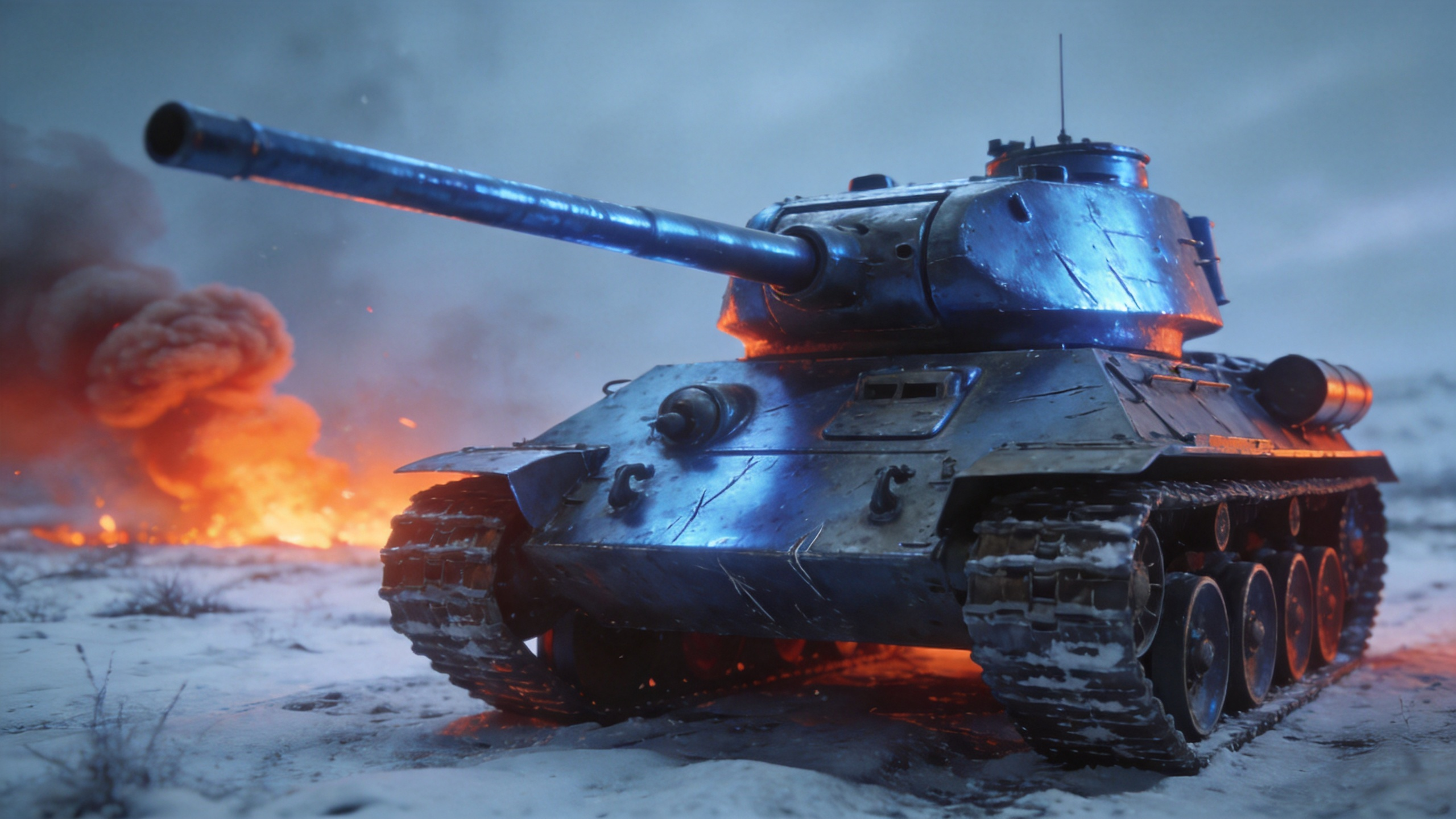
It is the fifth game to support DLSS 5, and the first competitive shooter to sell a one-week integration as a feature. According to a KuaiTech report published on 13 November 2026, the "Eagle Shadow" update shipped the neural rendering path in full, and art director Kirill Stupin was blunt about the decision: there was no reason not to implement it.
What the Eagle Shadow update actually changed
Dagor is Gaijin's own engine, in service for over a decade. Dropping a new rendering stage into something that old is normally a quarterly project. Doing it in under seven days says something specific: the barrier to DLSS 5 is no longer capability, it is willingness.
The difference between DLSS 5 and conventional upscaling sits in the input. Upscalers take a low-resolution frame and guess pixels. DLSS 5 reads the engine's 3D buffers and injects photoreal materials and lighting late in the frame, so it is not enlarging an image, it is repainting detail the artists never authored.
Under a week, from SDK to shipped
If integration costs a quarter, only large studios bother. If it costs a week, mid-sized teams add it on a Tuesday. Stupin said the original demo looked almost too good to be true, and that real content through the pipeline produced the war imagery the team wanted.
The 400 fps math: two cards, one 1.5x gap
At 4K in performance mode, War Thunder runs above 400 fps on an RTX 5090. An RTX 5080 averages 262 fps.
Why frame rate matters in a vehicle shooter
Turret traverse, rangefinder readouts, ballistic drop compensation: all of it lands on input latency. Higher frame rates make the controls feel closer to instinct, and in a game decided by milliseconds that is not vanity.
Both figures also rely on multi-frame generation. DLSS 5 can synthesize up to six frames per rendered frame, which means a meaningful share of what you see at 400 fps is computed rather than drawn.
The bill Nvidia admits to: 50-60% base performance
This is the sentence worth remembering. Nvidia states plainly that enabling DLSS 5 reduces base performance by 50 to 60 percent.
In player terms: a rig that used to hold 120 fps now renders somewhere around 50, and frame generation pushes the counter back up to 300 or 400. The number on screen climbs, and how it feels depends entirely on how stable the interpolation is.
Six-times frame generation is not free input response
Generated frames carry no real input. Whether the game feels responsive depends on how accurately the model predicts between two rendered frames. Competitive players would rather have 200 native frames than 400 where 250 are guesses.
So DLSS 5 works less like a free upgrade than a performance tax: half your compute for nicer materials and a bigger counter. High-end buyers shrug; mid-range cards fall outside the fence.
The argument isn't frame rate, it's authorship
The loudest fight in the community is not about fps. It is about whether the image is still the one the artists made.
DLSS 5 generates materials and lighting with a model. It sharpens armor specular, environment reflections, and shadow physics, layered on top of path-traced global illumination that War Thunder already supported. Nobody has drawn the line between restoring and redrawing.
Semantic masks are an engineering answer
Stupin's answer is technical: developers can tune structure strength and semantic masks so the AI does not break the intended art style. That is both a rebuttal and an admission. Left untuned, the model will change the look.
My reading is that this is a credit question dressed as a graphics question. When the final pass is decided by a model, how much of the art team's intent survives is something the industry will eventually have to answer.
This isn't one game's problem: consoles and handhelds are in the same race
Zoom out: the seven-day integration is one link in a longer chain.
Xbox's next GPU is 40% ahead on paper
KuaiTech's 7 November 2026 roundup of leaks puts Sony's PS6, codenamed Orion, on a 10-core Zen 6 CPU with 52 to 54 compute units and roughly 40 TFLOPS. Microsoft's Xbox Next, codenamed Project Helix, is listed at 11 to 12 cores, 68 compute units, and 56 TFLOPS, about 40 percent more GPU throughput on paper, with up to 48GB of memory and a reported starting price around 7,000 yuan.
Handhelds got OLED and 120 Hz first
The ROG Xbox Ally X 20th Anniversary Edition moves from a 7-inch LCD to a 7.4-inch 1080p 120Hz OLED, increases heatsink area by 11 percent, and lifts fan airflow about 20 percent, at the cost of 756 grams, 41 grams heavier than the standard model (ITHome hands-on, 4 November 2026).
Three product lines, one direction: hardware pays for software, and software is redefining "native rendering". Track that thread in GameHub's hardware section.
My read: a "standard-issue tax" arrives in 2027
DLSS 5 will not spend three years arguing the way ray tracing did. Ray tracing made games look better; DLSS 5 makes them hit frame targets. Once a top competitive title markets 400 fps, every other team has two options: adopt it, or explain why their image is behind.
The risk is not 2026, it is 2027. When "supports DLSS 5" becomes a required line on a store page, it collects in two currencies: hardware, as mid-range cards age out, and aesthetics, as metal reflections across the industry converge on the same look.
The counterargument holds too. If interpolation latency turns out to be measurable in competitive play, players will vote with their feet and the narrative deflates quickly. Stupin's "no reason not to" is a developer's efficiency judgment, not a player's experience judgment, and the two frequently disagree.
FAQ: three questions players keep asking
Does War Thunder support DLSS 5 now?
A: Yes. The Eagle Shadow update released on 13 November 2026 integrates DLSS 5 fully, making War Thunder the fifth title to support it, with Dagor integration taking under a week.
Is DLSS 5 worth enabling, and how much performance does it cost?
A: Nvidia's official figure is a 50 to 60 percent drop in base performance, recovered by up to six-times frame generation. An RTX 5090 exceeds 400 fps at 4K performance mode and an RTX 5080 averages 262 fps.
Will it run on a card that isn't a 50-series?
A: It will run, but without this tier of benefit. Public benchmarks cover only the RTX 5090 and RTX 5080; mid-range cards fall to much lower base frame rates that upscaling must rescue.
A 400 fps counter or a 50 fps native floor: which would you take? Tell us in the comments, and post your own measured numbers. We will turn reader data into a comparison table for gghubs.com.