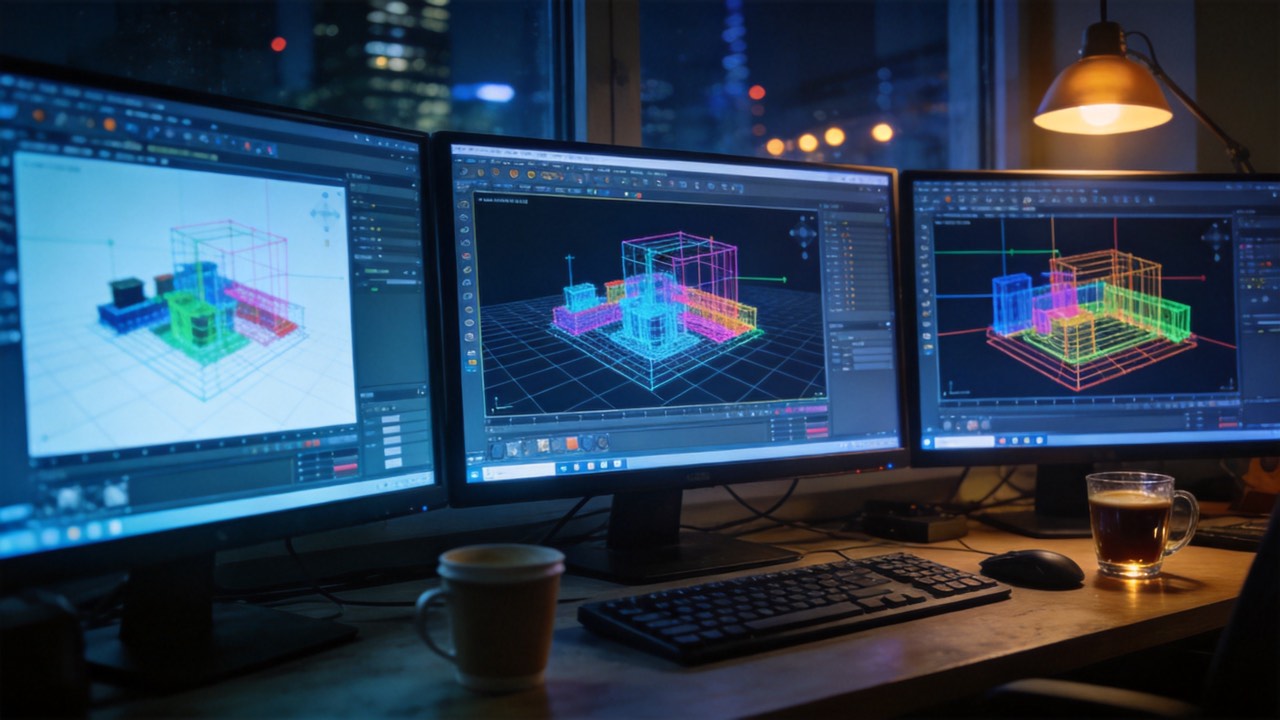
the company behind the world's most widely used game engine is being priced by the same consortium that bought Electronic Arts. The reported valuation implies a premium of about 16 percent. The Information broke the story, Reuters followed, Unity has engaged an investment bank, and none of the three parties has commented publicly. The interesting question for developers is not who signs the cheque — it is what happens to pricing once the engine changes hands.
Why $25 billion is a valuation, not a price tag
Start with the arithmetic. Reuters puts the deal at a valuation of about $25 billion. KitGuru, citing the same report, notes that Unity's market capitalization sits closer to $21.5 billion following its latest earnings. The gap is roughly $3.5 billion, or about 16 percent.
That gap tells you the buyer is not bargain hunting. Public markets say $21.5 billion. A buyout says $25 billion. The difference is the cost of getting existing shareholders to say yes.
The second detail matters just as much: Unity has been working with an investment bank on the approach. Companies hire bankers when they are evaluating seriously — and when they want a credible answer to the question "what happens if we don't sell?"
The 16 percent gap
Sixteen percent is neither aggressive nor generous by M&A standards. For a company whose share price has swung repeatedly, it reads like an opening offer. Where it ends depends on due diligence: which part of the business — engine subscriptions, advertising, enterprise licensing — is being marked down.
Silver Lake's 8% stake is the ticket to the table
Silver Lake is not a stranger arriving with a suitcase of cash. It invested up to $400 million in Unity back in 2017 and still holds roughly 8 percent, making it one of the largest shareholders.
That is why these talks started in a boardroom rather than on the open market. A shareholder who has held a seat for eight years, who can read both the financials and the technical roadmap, does not need to build trust from zero before proposing a buyout.
The same consortium just closed a $55 billion EA buyout
Put the two deals side by side and the logic is obvious. Just months ago, a consortium led by Silver Lake and PIF completed the take-private of Electronic Arts for $55 billion.
Content on one side, tools on the other
Buying EA gets you franchises, studios and publishing muscle. Buying Unity gets you the doorway everyone else has to walk through to ship a game. That is not diversification; it is two ends of the same pipeline. PIF's identity matters here too: sovereign money operates on a longer clock than a hedge fund, and it does not need a pretty quarter next month.
What a private Unity means for developers
Unity's engine and tools span PC, console and mobile development, from two-person indie teams to major publishers. If the deal closes, Unity goes from public company to private one.
A public company answers to quarterly earnings. A private company answers to one thing: whether cash flow covers the return its owners demand. Those two constraints push pricing in opposite directions.
Where pricing power moves
In the short term, signed contracts hold and annual licences renew as usual. Over the medium term, adjusting revenue share, raising enterprise thresholds, or moving features into pricier tiers no longer requires explaining itself to public markets. The 2023 runtime fee attempt was reversed by an unusually unified developer backlash. That pressure does not disappear under private ownership — but the owner no longer has to care what the press writes.
The risks: this deal may never happen
To be clear: this is an approach and a set of discussions. Reuters explicitly says a deal is not guaranteed, and Unity, Silver Lake and PIF have all declined to comment.
The second uncertainty is regulatory. When a sovereign fund is on the buy side, cross-border transactions tend to trigger investment screening, and neither the timeline nor the outcome is controlled by the parties.
The third is price. $25 billion is a reported valuation, not a signed number. If due diligence trims growth expectations, the number moves. Treating this as a done deal is running well ahead of the facts.
My read: engines are becoming infrastructure, not tools
The signal here matters more than the transaction. For a decade, game engines were treated as a software business: sell licences, sell subscriptions, sell services. Now they are being treated as infrastructure — whoever owns the production tool can charge rent across the entire content pipeline.
That is not purely bad for developers. Bargaining power does concentrate on the buy side, but infrastructure cannot simply be shut down or rebuilt on a whim. The scenario worth watching is capital holding both tools and content at once, using tool pricing to subsidise content losses. At that point your counterparty is not a vendor; it is a referee who also owns a team.
More coverage of engine economics and studio M&A is published regularly by GameHub , and gghubs.com keeps the original announcements on file so you can check the numbers yourself.
Unity's engine has just become a line item in every studio's budget. If a private owner raised the revenue share by 20 percent, would you migrate to Unreal or Godot — or just pay? Tell us in the comments.
FAQ
Is the deal actually happening?
A: No. Reuters describes weeks of discussions, not a signed agreement. Unity has engaged an investment bank, all three parties declined to comment, and the report states explicitly that no deal is guaranteed.
How far apart are the $25 billion valuation and Unity's market cap?
A: About $3.5 billion, or roughly 16 percent. Reuters puts the deal valuation near $25 billion; KitGuru cites a market capitalization of about $21.5 billion after Unity's latest earnings.
Will subscription prices rise if Unity goes private?
A: There is no official pricing statement, and any specific figure would be speculation. The relevant precedent is 2023, when a proposed runtime fee triggered a developer revolt and was later revised.