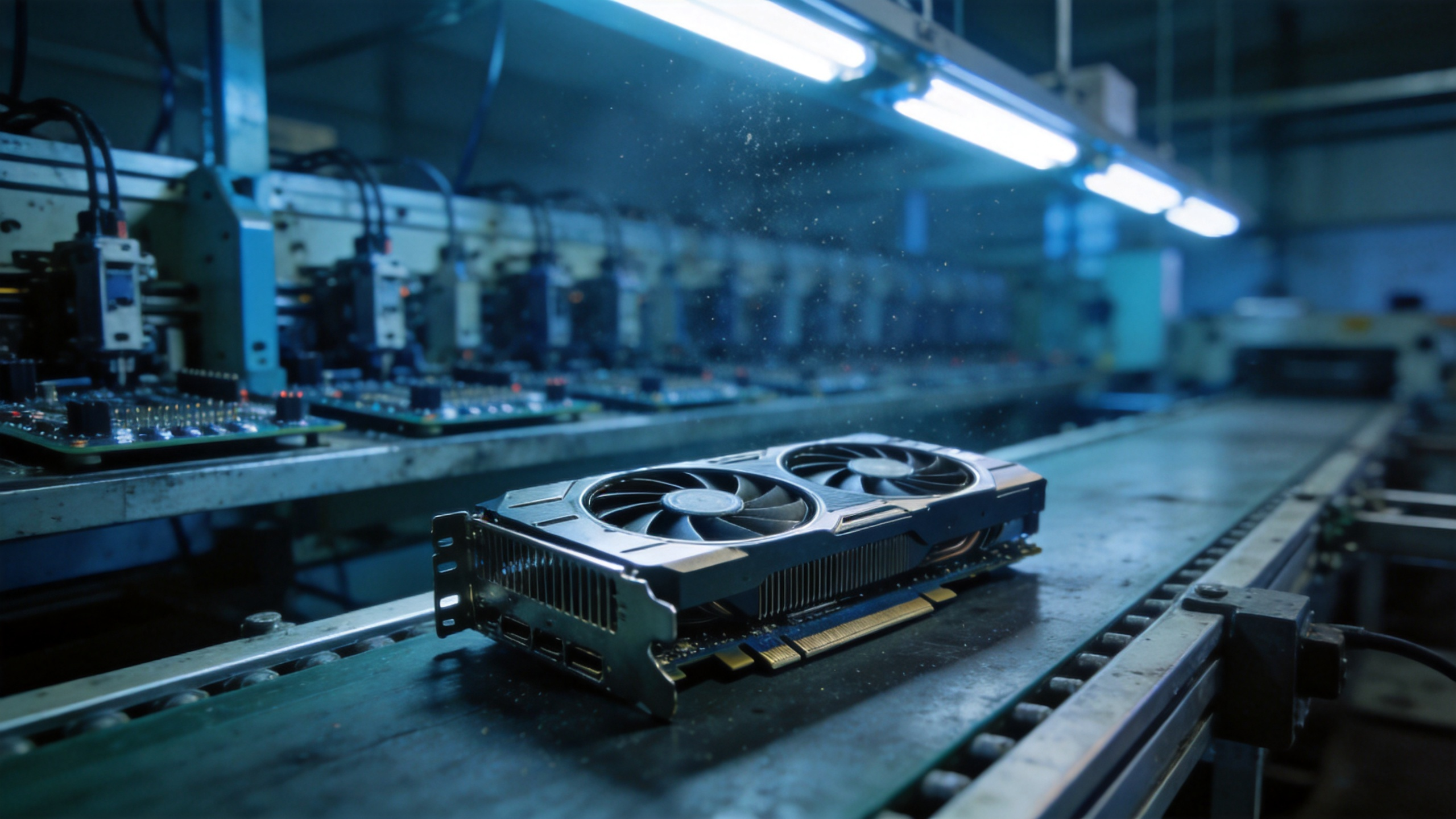
Nvidia has reportedly halted production of the RTX 5090, including the China-only D variants. The next flagship GeForce will be an RTX 5080 24GB, according to a leaked factory notice reported by Tom's Hardware and relayed by GamesIndustry.biz on October 12, 2026.A graphics card reaching end of life is normally a footnote. This one is not. In the same week the 5090 was reported dead, Sony was said to be weighing a PS6 delay into 2028 or later, Valve said its hardware plans are constrained by memory capacity, and Xbox warned that memory costs will shape the price and availability of Project Helix. One factory notice, four platforms, one shared bottleneck.
一、What the leaked notice actually says
Three claims, one silence from Nvidia
The notice posted by leaker @hongxing2020 is blunt: the factory has been told Nvidia will stop manufacturing every RTX 5090 model, D variants included, and that the top GeForce card becomes the RTX 5080 24GB while the 16GB 5080 is discontinued at the same time. A second leaker, @Zed__Wang, backed the claim and added that the GB202 die behind the 5090 will only go into data center and professional cards from now on.
Nvidia has not announced anything. Tom's Hardware asked for comment and got none. Until the company says otherwise, this remains a report, not a confirmed product change.
The silence is the interesting part. A routine generational handoff usually comes with advance notice, channel guidance and a clearance window. Here the factory knew first, the press knew second, and the company said nothing. That sequence suggests a decision made quickly, probably by people looking at memory allocation rather than at gamers.
二、The 5090 is not selling badly. Memory is just worth more elsewhere
GB202 gets reassigned
The most expensive part of a 5090 is not the GPU core. It is the stack of memory wrapped around it. When contract memory prices climb, the same GB202 die earns far more inside a data center accelerator than inside a consumer card. With limited capacity, nobody needs a meeting to decide where the wafers go.
The RTX 50 Super refresh, which was expected to bring a 24GB 5080 Super, has reportedly been held up by memory supply constraints, again per Tom's Hardware. Read those two stories together and the logic is plain: Nvidia cut the card that consumes the most memory and kept the silicon for product lines with better margins.
That is good for a quarterly report and bad for enthusiasts. The 5090 audience was always narrow, so killing it costs mindshare, not revenue.
三、The knock-on effects have already started
Sony, Valve and Xbox are all queuing for the same silicon
GamesIndustry.biz has previously reported three data points: Sony could push the PS6 to 2028 or 2029 because of the memory crisis, Valve said it is limited by memory capacity, and Xbox warned that memory costs would affect Project Helix's pricing and availability.
Put those next to a dead 5090 and the picture is coherent. Desktop GPUs, handhelds and consoles all draw on the same memory packages and the same assembly capacity. When the consumer flagship is the first casualty, the allocation order has already changed: AI and data center first, contract customers second, retail graphics cards last.
What players feel first is price. With the 5090 gone, secondhand listings will drift upward, the 5080 24GB becomes the new ceiling, and its performance is not the 5090's. Anyone buying in the next few weeks is paying a scarcity premium, not a performance premium.
四、Who actually wins when a flagship disappears
Not gamers, and not really the retail arm of any vendor. In shortage years the money sits with channel partners holding stock and with companies renting compute by the hour. Moving GB202 into data center products converts high-end gaming from something you buy once into something you rent.
Zoom out and the ceiling on gaming hardware is being repriced by AI demand. Nvidia has no obligation to prioritize players; it has an obligation to gross margin. That is an uncomfortable sentence for anyone who remembers when the flagship gaming card was the point of the company, but it describes how hardware allocation works in 2026.
五、The case against panic
Two things could prove this story wrong. First, Nvidia has confirmed nothing. Second, memory pricing is cyclical. If DRAM supply loosens in the first half of 2027, Nvidia can restart 5090 production or skip straight to the RTX 60 series, which rumors place at late 2027 at the earliest and possibly 2028.
That leaves a gap of roughly two years in which the 5080 24GB carries the top of the GeForce stack. If you were waiting for a reason to hold off on a 4K upgrade, the supply chain just handed you one.
六、My read: a flagship cut short by its own supply chain
The 5090's lifespan looks less like a product cycle and more like a scheduling casualty. It did not lose to a competitor. It lost to a more profitable use of the same silicon.
My advice is deliberately boring. If you already have a card that handles 1440p, this is not the moment to buy. Wait for independent benchmarks of the 5080 24GB, wait for memory pricing to show a direction, and then decide whether 4K is worth the premium. For readers tracking the hardware and platform side of this, GameHub 游戏资讯 keeps a running thread on it.
七、FAQ
Can I still buy an RTX 5090?
Retail and channel inventory may still exist, but factory output has reportedly stopped, so restocks will thin out. The China-market D variants are included in the reported halt. Expect wider price swings than usual.
Is the RTX 5080 24GB worth waiting for?
It becomes the top GeForce card, so expect pricing above the current 5080. It does not match 5090 performance; it solves a memory-capacity problem. Wait for measured frame rates before deciding.
Will memory prices push console prices up?
The pressure is already visible. Sony is reportedly weighing PS6 timing, Valve says it is limited by memory capacity, and Xbox says memory costs will affect Project Helix pricing and availability.
Is now a bad time to upgrade?
For 4K high-refresh buyers, yes. For 1440p players, less so: mid-range cards are less exposed to a flagship shutdown and may even dip while channels clear stock. Check your monitor before you check the rumor mill.
More hardware and platform coverage lives at gghubs.com.