The game entered the U.S. top 30 on November 12, hit No. 1 on both the overall and puzzle charts a week later, and had slipped to No. 2 by the time Chinese media covered it. Its Chinese counterpart shipped on November 2 and passed Honor of Kings and Peacekeeper Elite within nine days. AppBrain counts about 2.3 million installs in roughly five weeks, a 4.6-star average from 11,973 ratings, and top rankings in Canada and Germany as well.
The Climb: Top 30 to No. 1 in Seven Days
The game was not an overnight arrival. It spent early November moving up the middle of the U.S. charts, entered the overall top 30 on November 12, and took No. 1 on the overall games and puzzle charts on November 19. Six days later it was still there. By the time the Chinese report ran, it had dropped one place to No. 2, seventh overall.
What it actually is
Cross-checking the store art against third-party listings points to a familiar pattern: this is the overseas version of a Xiamen-built sorting game whose Chinese mini-game release broke out first. The app version, Super Sorter, launched on November 2 and passed Honor of Kings and Peacekeeper Elite to top China's iOS free chart within nine days. On Google Play the listed publisher is ABF ALPENHOF. The timeline is tight: October 22 release, top 30 on November 12, No. 1 on November 19 — 28 days from launch to the top of the U.S. charts.
Reaction One: Validate at Home, Then Copy Abroad
The route skips the most expensive step in games: proving the loop. Chinese mini-game platforms are cheap to test on and return data fast; two weeks tells you whether a mechanic retains anyone. Once it works, you swap the theme, the art and the language, and ship it west.
2.3 million installs and 4.6 stars
AppBrain's public numbers put the game at roughly 34 days old with about 2.3 million installs, a 4.6-star average across 11,973 ratings, a peak of No. 1 among free U.S. games, and top finishes in Canada and Germany. Version 1.0.23 was pushed on November 23, and the download weighs 253.70 MB. None of that is a miracle for a casual game. For a first month overseas, it is a good month.
Reaction Two: Within Two Weeks, the Clones Arrive
AppMagic's free-chart data shows a cluster of near-identical titles carrying the "Room Sort" tag in the U.S. puzzle category through November. That is the standard rhythm of China's ad-monetised mini-game sector: Jump Jump, Sheep a Sheep, Catch the Goose — every hit is followed by a batch of reskins within a fortnight.
Why It Worked: A Theme Window and Industrialised User Acquisition
The mechanic is old, the theme was open
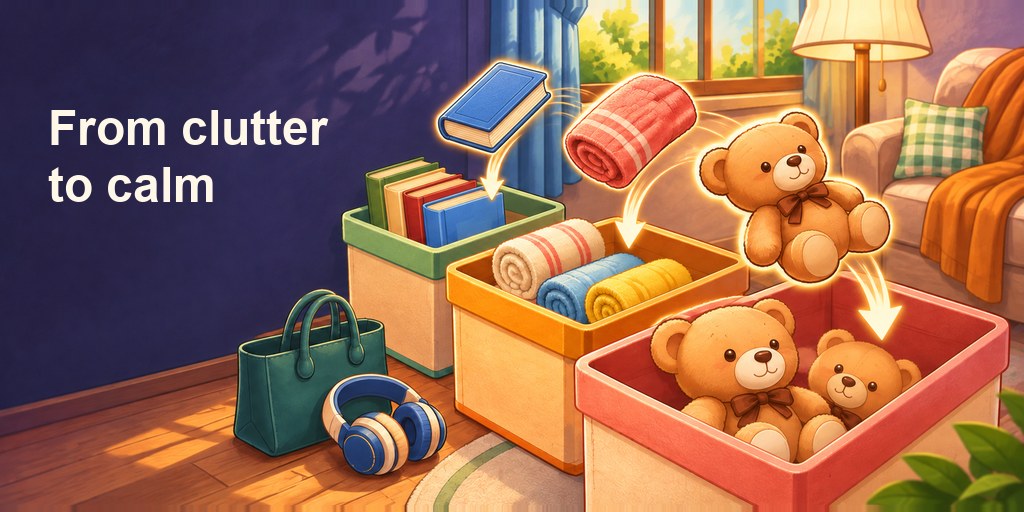
Sorting and tidying is not saturated worldwide yet, and the satisfaction of turning mess into order needs no translation and no story. The Play listing puts it plainly: "Find matching items, fill the right boxes, and tidy up cozy rooms." The loop is simple enough to explain in a three-second ad, which is the quality that matters most in this business: creative that runs itself. The product also skips accounts entirely and stores progress on the device, so there is one less sign-up between an ad click and a session.
Where the Window Closes
The window lasts weeks. Clones arrive, acquisition costs rise, unit economics slide — the fixed ending of every mini-game hit. Platform algorithms throttle lookalike content, and the closer a clone sits to the original, the harder it is to buy traffic. Once the theme dividend is gone, retention and level design decide the outcome, and that is usually where fast-follow teams are weakest.
One clarification matters: six days at No. 1 was on the free charts. Free-chart leadership measures acquisition efficiency, not revenue.
My Read: The Process Copies, the Window Does Not
This is not China conquering the U.S. market. It is capability transfer: the domestic pipeline of validate, industrialise the creative, ship overseas, aimed at a theme nobody had saturated.
The process can be copied. The window cannot. These windows usually last one to two months — once rivals bid up keywords and creative inventory, the first mover is left with retention as its only edge. By the time this batch of Room Sort titles finishes educating the market, the next hit will need a different theme.
gghubs keeps a running file on overseas publishing and the mini-game sector.
FAQ
How does the game make money?
A: Through ads. It is free to download, rewarded videos grant extra slots, tools or energy, and interstitials run between levels. The Google Play listing discloses ads, and the download is about 253.70 MB.
Why can a Chinese mini-game hit the U.S. charts directly?
A: The loop is validated on Chinese mini-game platforms first, where testing is cheap, then re-skinned and localised for overseas release. The Chinese app version had already produced the retention and monetisation data the overseas build needed.
What does six days at No. 1 mean?
A: It ranked first on the U.S. overall game charts for six consecutive days from November 19, then fell to No. 2 and seventh overall. AppBrain also records a peak of No. 1 on Google Play's U.S. top free games chart. This is a free-chart measure, not revenue.
Is it too late to follow?
A: The window is narrowing. AppMagic shows a dense cluster of Room Sort titles in the U.S. in November, which pushes acquisition costs up. Without an edge in creative or retention, following now carries more risk than upside.