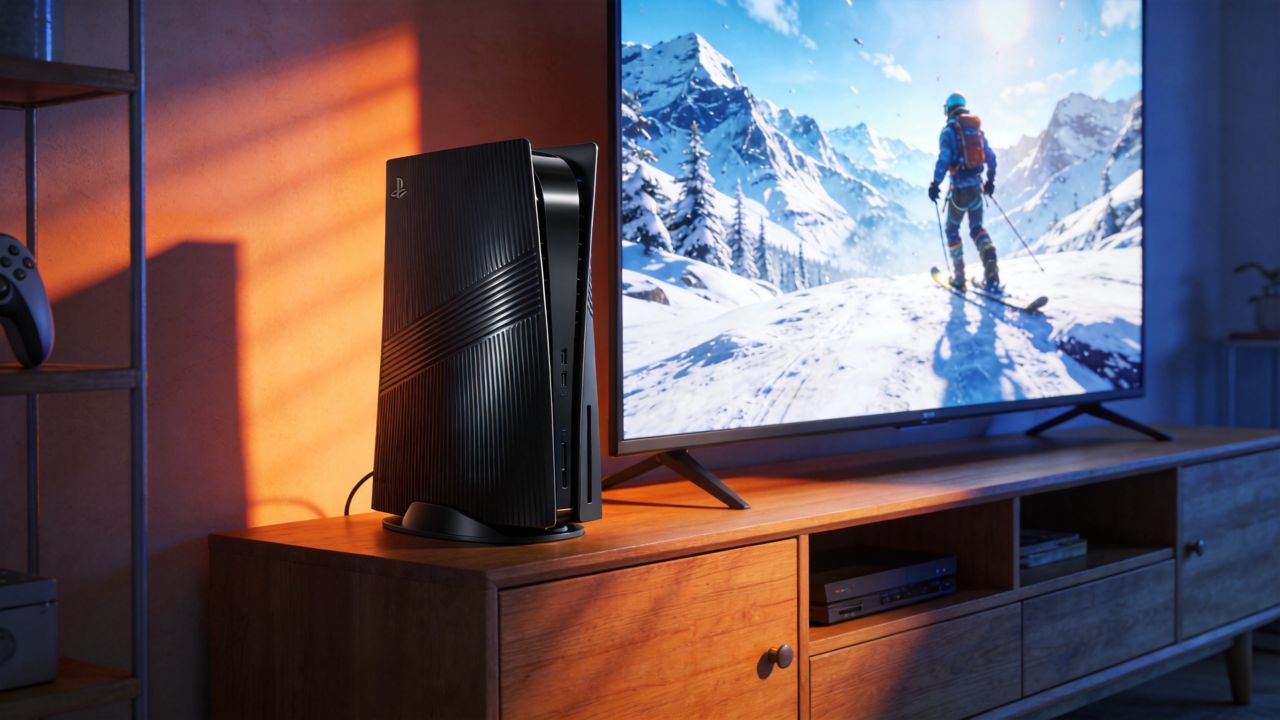
Microsoft calls its next console Project Helix, and its own framing is "a console that can also play your PC games." Reports put it in the 2028 holiday window at $1,200 to $1,800.
One sentence defines it: a console, not a PC
In an interview for the "XBOX — The 25th Anniversary" magazine, Xbox vice president of next generation Jason Ronald drew the line clearly: Helix is "designed to be a console that can also play your PC games, not a PC that can also play your console games."
Why that sentence matters
For a decade, the industry's default direction was console-PC convergence: upgradable, moddable, keyboard-and-mouse ready. Ronald reverses it. A console is magic, he argues, because "my games are instantly playable. I don't have to worry about updating an operating system, updating drivers, configuring settings."
Translation: Microsoft is not selling you a cheap computer. It is selling a games machine that does not require maintenance — one that also happens to run Steam.
Four generations of library come along
Ronald says players can bring their libraries and save progress across four Xbox generations to Helix, covering the original Xbox, Xbox 360, Xbox One and Xbox Series. That is not new: at GDC in March 2026, Xbox CEO Asha Sharma confirmed Helix would run both console and PC games and claimed "performance leadership" on both.
Dev kits in 2027, on shelves in 2028?
The hardware uses a custom AMD SoC co-designed with the next generation of DirectX and FSR, with Microsoft claiming an order-of-magnitude improvement in ray tracing. Dev kits are said to go out in 2027, with launch pointing at the 2028 holiday season; the $1,200-$1,800 range comes from reporting last month and has not been confirmed by Microsoft.
Why $1,200 is plausible: memory is up 2.5x
On June 25, 2026, Microsoft announced worldwide price increases effective August 1, with unusually blunt reasoning: console storage and memory costs had risen more than 2.5x and were expected to double again by autumn 2027. It was the second Xbox price increase in under a year.
The same curve showed up in China
China National Radio reported in September 2026 that general-purpose memory contract prices rose more than 58% quarter on quarter in Q2, while SSD prices jumped over 70% — the steepest single quarter in roughly fifteen years. Mainstream gaming PCs cost 2,800 to 4,500 yuan more than the previous summer. The cause is not mysterious: AI datacentres are absorbing high-bandwidth memory and wafer capacity.
The price rise already happened once, and sales answered
Third-party tracking cited in Chinese industry reports says US console sales fell sharply year on year in August 2026, with one product line hitting its lowest level since 2013 and another at a 25-year low. Those figures use inconsistent methodologies and are not financial disclosures, but the direction is clear: price increases killed the upgrade cycle.
The console business has always run on selling hardware near cost and recovering through software and subscriptions. When memory prices jump, both ends of that equation suffer: hardware costs rise, and the software revenue that was supposed to subsidise them is diluted by users who balked at the new price.
Neural rendering is about cost, not spectacle
Ronald lists neural rendering as a Helix priority, and his reason is not prettier pixels but "a new way of generating frames without requiring more compute and additional memory." In a year when VRAM and DRAM prices are the constraint, that sentence means: substitute algorithms for silicon.
He predicts more innovation in the next three to five years than in the past decade. Treat it as marketing if you like, but the direction is right. When silicon gets expensive, the only way forward is making each frame cheaper to compute.
My read
Helix is not really betting on being the most powerful console. It is betting on being the PC in the living room. At $1,200 to $1,800 it sits squarely in mid-to-high-end prebuilt territory, so Microsoft no longer has to argue "cheaper than a PC." It has to argue "less hassle than a PC."
That is also the risk. If memory prices double again by launch, as Microsoft itself expects, $1,800 may be the floor rather than the ceiling. And two years is long enough for handhelds, cloud streaming and subscriptions to become the cheaper answer. As for exclusives, Microsoft has spent the past few years diluting that word almost out of existence.
Put differently: Helix's price is not a pricing-strategy problem, it is a business-model problem. Once hardware stops subsidising software, a console has to sell on experience rather than on locked-up content.
When does Project Helix launch and what does it cost
A: Unconfirmed. What is verifiable is dev kits in 2027; the launch window and the $1,200-$1,800 range come from reporting, and Microsoft has not announced an official price or date.
Will it play older Xbox games
A: Yes. Microsoft says libraries and save progress from the original Xbox, Xbox 360, Xbox One and Xbox Series carry over, a compatibility commitment Xbox's CEO confirmed in March 2026.
Why are consoles getting more expensive
A: Memory and storage. Microsoft says related component costs rose more than 2.5x and expects another doubling by autumn 2027; Q2 2026 memory contract prices rose over 58% quarter on quarter and SSDs over 70%.
Pricing and timing remain subject to Microsoft's official announcements. More console and hardware coverage is available on GameHub's news desk.
If Helix really costs $1,200, would you buy it — or build a PC with the money? Tell us your walk-away price.