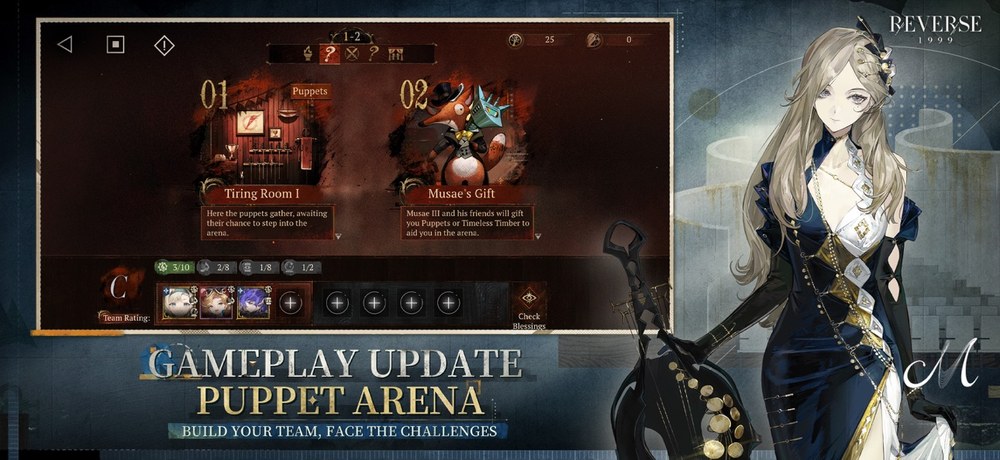
This reverse 1999 beginner guide 2026 explains the 4.0 build order: why Insight comes before Psychubes, why Resonance beats stacking raw levels, how to build teams for Mane's Bulletin and high-difficulty stages around stage mechanics, and where beginners should put materials first. Strength conclusions follow in-game data and official announcements, and this guide sticks to executable ordering decisions.More Reverse: 1999 guides at gghubs.com.
 Applicable version: 4.0.0 (updated 2026-09-24)
Reverse: 1999 4.0 Build Framework: Four Layers
The progression system breaks into four layers: level and Portray, Insight levels, Resonance levels, and Psychubes with amplification . The last two decide the ceiling; the first two are more of a gate.
Cost curves across the four layers
Levelling is linear input for linear return, cheap but flat. Insight unlocks in steps, each bringing a clear mechanical or numeric jump. Resonance and Psychubes are configuration-type investments: pick the right direction and returns spike, pick wrong and the materials vanish .
Why order beats volume
The four layers do not fully share materials, but resin and resources are common to all of them. Pushing a main dealer's Insight to its key passive before touching Psychubes lets the same materials work simultaneously in story stages, Mane's Bulletin, and high-difficulty content.

Reverse: 1999 Psychube Choice: By Output Pattern, Not Rarity
Psychubes are the closest thing to equipment in Reverse: 1999, and rarity is not the deciding factor.
| Main dealer output | Psychube direction | Basis |
|---|---|---|
| Ultimate burst windows | Amplify burst-phase damage | Damage is concentrated in one round |
| Sustained basic attacks | Amplify general output and damage bonuses | Damage spreads across rounds |
| Affinity exploitation | Amplify the matching affinity's gains | Enemy affinity decides the payoff |
Amplification last
Psychube amplification raises the Psychube's own numbers, which only pays off once the direction is settled . Amplification is irreversible, so materials spent there do not come back if the direction changes. Treat it as a finishing step for a build you have already test-run in a real stage, never as a speculative upgrade.
Supports rank below the main dealer
Support Psychubes mostly provide utility and survivability, with a flatter return curve . Concentrating Psychube materials on one or two main dealers during the early game clears higher Mane's Bulletin floors than spreading them evenly.
Reverse: 1999 Resonance: Ahead of Raw Levels
Resonance raises character stats systematically, and its return has one defining trait: the earlier you do it, the more content it covers.
Why Resonance outranks levels
Levelling raises base stats, while Resonance adds multipliers and extra attributes . For the same material cost, Resonance shows up more clearly in practice, especially in high-difficulty stages.
Not every character deserves a full board
Resonance is not worth maxing on everyone. The test is whether a character stays in your main team long term. Transitional units or mechanic-specific picks can stop at functional levels, leaving resources for the core .
Reverse: 1999 Mane's Bulletin Team Building
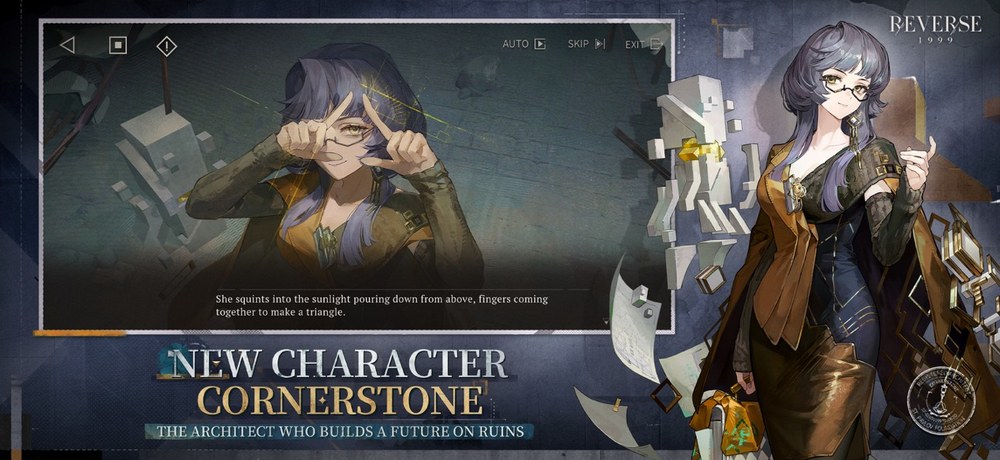
High-difficulty content like Mane's Bulletin tests whether you build around mechanics rather than around raw strength.
Read the stage mechanic before building
Stage mechanics often limit turn counts, healing, or specific damage types, so the restrictions come first . Putting this step first matters because even a strong team fails if it violates the rules.
The three-role core
A team that clears reliably needs three functional roles: a main damage dealer, a support providing buffs, and a slot handling control or healing . Missing a role usually stalls one phase rather than reducing total damage.
Swap characters, not gear
The deciding factor in hard stages is usually the character choice rather than gear tweaks. So when you stall, swap a functional role before adjusting Psychubes.

Reverse: 1999 Beginner Resource Order
| Priority | Target | Reason |
|---|---|---|
| 1 | Insight levels on your main dealer | Unlocks mechanic steps that apply everywhere |
| 2 | That dealer's Psychube | Configuration investment with a high ceiling |
| 3 | Support Psychubes and Resonance | Keeps the rotation and survivability intact |
| 4 | Psychube amplification and secondary Resonance | Only after direction is locked |
Version content follows official announcements
Characters, events, and banner schedules for 4.0.0 are subject to official announcements . This guide avoids unconfirmed numbers; for exact multipliers and rates, read the in-game description pages.
Farming materials efficiently
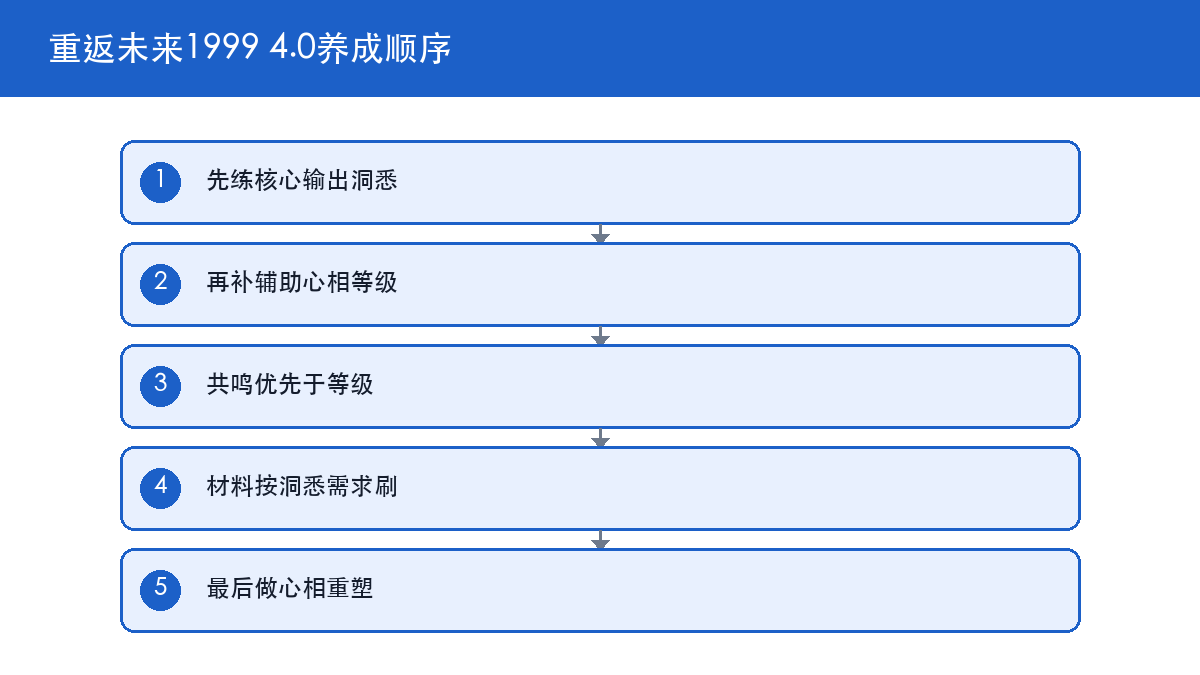
Farm in the order of Insight needs, then Psychube needs, then Resonance needs, rather than stocking every type at once . Exchange windows from earlier versions close on rotation, so claim whatever is currently available before farming.

Reverse: 1999 4.0 FAQ
When did version 4.0 launch?
A: The official site lists an update date of 2026.09.24, and the current version is 4.0.0 .
Insight or Psychube first?
A: Insight on your main dealer first, to unlock mechanic steps, then Psychubes, since the two layers use different materials .
Is it worth maxing Resonance on everyone?
A: No. It is worth it on characters that stay in your main team; transitional or mechanic-specific picks only need functional levels.
When should I amplify a Psychube?
A: After the Psychube direction is settled. Amplification is irreversible and materials are not returned.
What should I change first when stuck in a hard stage?
A: Swap a functional role first, then consider gear tweaks; stage mechanics are usually the bottleneck .