
The live build is 1.0.5 (2026-09-15); 1.0 proper landed on 2026-07-10, and that is when the breeding system was rebuilt from the ground up. In other words, any breeding guide written before July 2026 is basically disposable — cakes went from one type to five tiers, tower legends became same-species only, and active skills now inherit from equipped slots. What follows tracks a single line: set the target, pick the cake, deal with the duds. The version log and breeding tables stay updated at gghubs.com. The step most Palworld breeding guides skip is the first one: people grab two Pals, start breeding, and then spend twenty hours chasing a combination they could have reached in a single move.

Palworld 1.0.5 Breeding: Working Backward from the Target
The requirements are simple: one male and one female in the Ranch, a cake in the box, then wait for the egg. Any Pal breeds with any other Pal — species, element, and rarity do not matter — so the real bottleneck is not whether you can breed, but what passives the offspring comes out with.
Work in reverse. Decide which Pal you want first, run the pairing through a breeding calculator to find the two species that produce it, and go catch only those two. Do it the other way around — pair up whatever you happen to have on hand — and you will usually find that the thing you wanted was never in that combination table to begin with.
Extra passives on the parents go straight into the inheritance pool, and the dirtier the pool, the lower the odds that your target passives survive. Check the passives on every Pal you catch: keep the ones carrying target passives, and send the rest to the Condenser without sentiment.
I would rather make a few extra trips at the parent-catching stage, because that is what sets the expected value for the dozens of hatches that follow. With clean parents, four-passive offspring show up within twenty hatches far more often; with dirty parents, you just keep circling the same pile of junk passives.

Palworld Cake Selection: What Each of the Five Tiers Changes
1.0 added four specialty cakes on top of the standard one, five in total. None of them ever change the offspring's species — they only affect egg count, egg quality, and the mutation and passive-inheritance rates. The table below covers what each one does.
| Cake | Effect | When to Use |
|---|---|---|
| Standard Cake | Baseline breeding | First test of a new pairing |
| Mushroom Cake | Slightly higher odds of high stats | IV-chasing projects |
| Vegetable Cake | Two eggs per breeding | When you need a large pool of candidates |
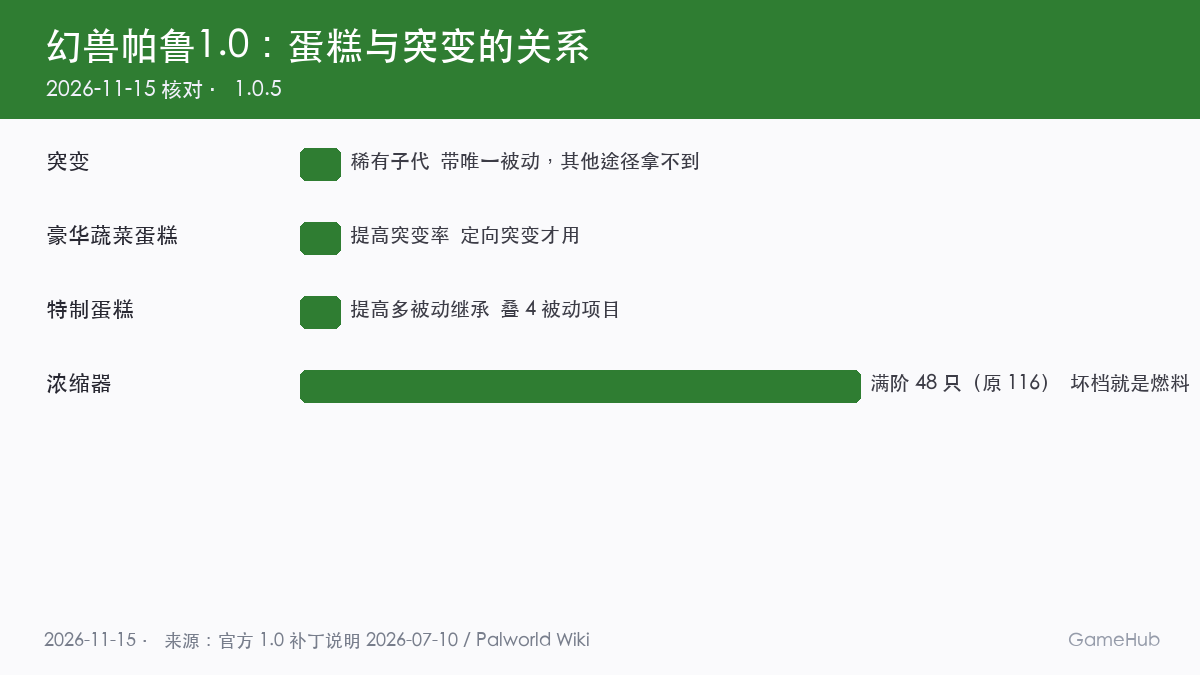
| Luxury Vegetable Cake | Higher mutation rate and stat growth | Deliberately hunting mutated offspring |
| Special Cake | Higher chance of inheriting multiple passives | Four-passive stacking projects |
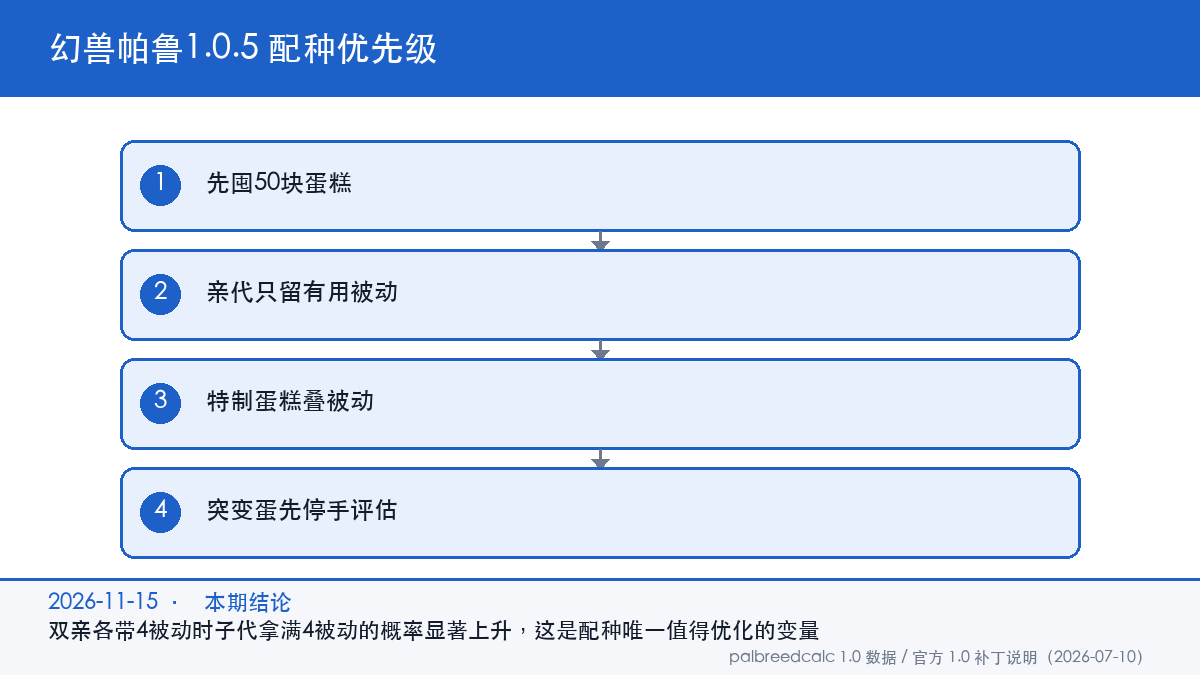
Cakes are consumables — one per breeding. A "perfect four-passive individual" project usually runs thirty to fifty attempts, so stockpile fifty before you open a long run; do not let the line stall halfway while you go gather ingredients.
How you choose depends on what this run is for. Chasing a mutation? Luxury Vegetable. Chasing passives? Special. Mixing the two means you are not specialized in either direction. Whether the species is right has nothing to do with the cake — swapping cakes will not change what you get.

Palworld Passive Inheritance: Why Full-Passive Parents Matter
The community has run the code analysis and the calculator data, and the rule comes out like this: the offspring inherits randomly from the combined passive pool of both parents, with duplicates removed, expecting four and inheriting at least one. When both parents carry a full four passives, the chance that the offspring lands all four rises substantially.
With two blank parents at zero passives, the odds of the offspring reaching four are around 10%, and most offspring carry only one or two. That is why "just grab two Pals" is so inefficient — it is not bad luck, there is simply not much in the pool to draw from.
Active skills inherit as well, and this part you control. Since 1.0, active skills are inherited randomly from the three active-skill slots each parent currently has equipped, so swapping the parents' active skills before breeding effectively designs the offspring's skill pool in advance.
One more category gets overlooked constantly: some worker Pals carry WorkAura, which grants other Pals in the base working the same job +1 work suitability level, and the trait also passes down through breeding. If you want base production maxed out, the worker breeding line is worth as much as the combat line.

Palworld Mutations: The Unique Passive and When to Walk Away
Every breeding carries a small chance of a mutation egg. A mutated offspring's base stats sit a tier above a standard offspring from the same parents, it carries a unique passive that no other route can produce, and the Palpedia flags it distinctly.
The developers keep that rate very low, and most hatches are still ordinary offspring. So mutations cannot be your main objective — treat them as a byproduct. If you genuinely want to farm them, get the Luxury Vegetable Cake line running first.
When a hatch comes out with the mutation marker, do not celebrate yet: read its unique passive before deciding whether to keep it. Dumping it straight into stat-stacking is the most common waste in the game — some mutation passives are the core of this patch in their own right.
Palworld Condenser: What 48 Pals per Max Rank Means
1.0 brought the Condenser's cost down: maxing a Pal's rank now costs 48 Pals, against 116 in early access — roughly a 60% cut.
What 48 changes is the call on whether a bad roll is worth keeping. A Pal with a single useful passive used to be pure waste; now it is fuel. The Pal Souls the Condenser produces can permanently boost a chosen Pal's individual stat.
To push stats further than the Condenser allows, you need Awakening: harvest Radiant Gems deep in the World Tree and push a chosen Pal's stats past the natural level cap. That is endgame content — no need to think about it until you have finished the World Tree.
Palworld 1.0 Changes: Tower Legends Are Same-Species Only
In early access, those five tower boss Pals could be bred from mixed parents. Since 1.0 they breed same-species only — Faleris, Shadowbeak, Grizzbolt, Orserk, and Lyleen are all species-locked.
If you still have a mixed-breeding table from before 1.0, delete it. Breed by the old table and the result is simply "not that Pal"; the game throws no error at all, it just leaves you convinced the calculator is broken.
1.0 also added another route, gene recombination: through the high-tier breeding farm variant, you fuse a legendary Pal's genes into a mutant offspring that keeps the legendary stat curve while inheriting passives from a non-legendary partner. That is endgame play — do not touch it until you have cleared a full World Tree run.
Palworld Breeding FAQ
Do cakes really change the species?
A: No. The five cakes change exactly three things: egg count, stat quality, and the mutation and passive-inheritance rates. Species is decided by the parent combination.
Can two blank parents still produce four passives?
A: Yes, but the odds are only about 10%, and most offspring carry one or two. For reliable results, give each parent its target passives first.
How often do mutations appear?
A: The developers keep the rate under 10%, so it is a rare event. Deliberate mutation farming means Luxury Vegetable Cake.
Can the tower legends still be crossbred?
A: No. Since 1.0, Faleris, Shadowbeak, Grizzbolt, Orserk, and Lyleen breed same-species only, and the old mixed-breeding tables no longer work.
Action Checklist
- Run the breeding calculator backward from your target offspring to find the parent pairing, then decide what to catch.
- Stockpile fifty cakes before starting a long project; do not let the line stop.
- Keep only parents carrying target passives; send blank individuals straight to the Condenser.
- Special Cake for passives, Luxury Vegetable Cake for mutations — do not mix them.
- When a mutation hatches, read the unique passive before deciding; duds go into the Condenser (48 Pals per max rank).