
This Love and Deepspace tier list-adjacent piece answers one question: in what order do you build a main damage dealer's cores. Character tier list debates settle who to raise; this settles what "raised" actually costs in Starry Shards and upgrade materials.
Love and Deepspace Core System: Shards and Hunt Stages
Applicable version: official notices as the source of truth (the official site has no version field; the client version follows the app store)
What one hunt costs and returns
Each Core Hunt entry costs 20 Starry Shards and always drops 5 cores. Stage 8 guarantees 1 gold, 1 purple and 2 blues, with the fifth core rolling between qualities at 20% gold, 40% purple and 40% blue (source: bwiki Love and Deepspace Core Hunt page, checked 2026). That is the whole economy: expected gold per run is about 1.2.
Stage gates
Hunt stage 1 requires Hunter Level 27 and recommends Memory level 15; stage 7 requires Hunter Level 55 and recommends Memory level 60 (source: same page). Do not farm low stages to fill the time; gold rates there are close to zero.
Hunt stages rotate the set on offer by weekday (source: same page). This matters more than it looks: farming a set that is not on today's schedule wastes shards that never come back, so the cheapest daily habit is checking the schedule before you tap in.

Love and Deepspace Core Main Stats
Main DPS versus support
Main DPS cores want ATK and crit main stats; supports want HP and DEF (source: in-game core stat panel). This is not folklore: the main stat multiplies into the final number while substats only add.
Main stat beats substats
A correction worth making: it is not "pretty substats make a core worth upgrading", it is "wrong main stat means transition gear no matter how pretty". The order is always main stat, then set piece count, then substats.
Do not force the set count
Do not. During transition, main stat value beats set-piece value, and you lose less by backfilling the set later. Set bonuses are fixed values, main stats are multipliers, and the multiplier wins when they conflict.

Love and Deepspace Core Substats
ATK and crit come first
Substat priority runs ATK%, Crit Rate, Crit DMG, then flat ATK, then HP and DEF (source: community progression consensus, not an official figure). Crit pairs are the core for a main DPS and ATK% is second.
Balance the crit pair
Crit Rate to Crit DMG follows roughly a 1:2 rule: at 50% Crit Rate, about 100% Crit DMG is the sweet spot (source: community consensus, not an official figure). Off that ratio, the surplus stat gets eaten by diminishing returns, which is why "biggest number" is the wrong filter.
When not to upgrade
Do not upgrade a core with a single useful substat. Upgrade materials come in slower than shards, so spending them on a one-stat core locks resources into transition gear, and none of it comes back when the replacement drops.
Three useful substats is finished
Three useful substats is the finish line. The fourth costs several times the first three and adds a few percentage points; in practice the clear-time difference is usually under five seconds.

Love and Deepspace Core Upgrade Order
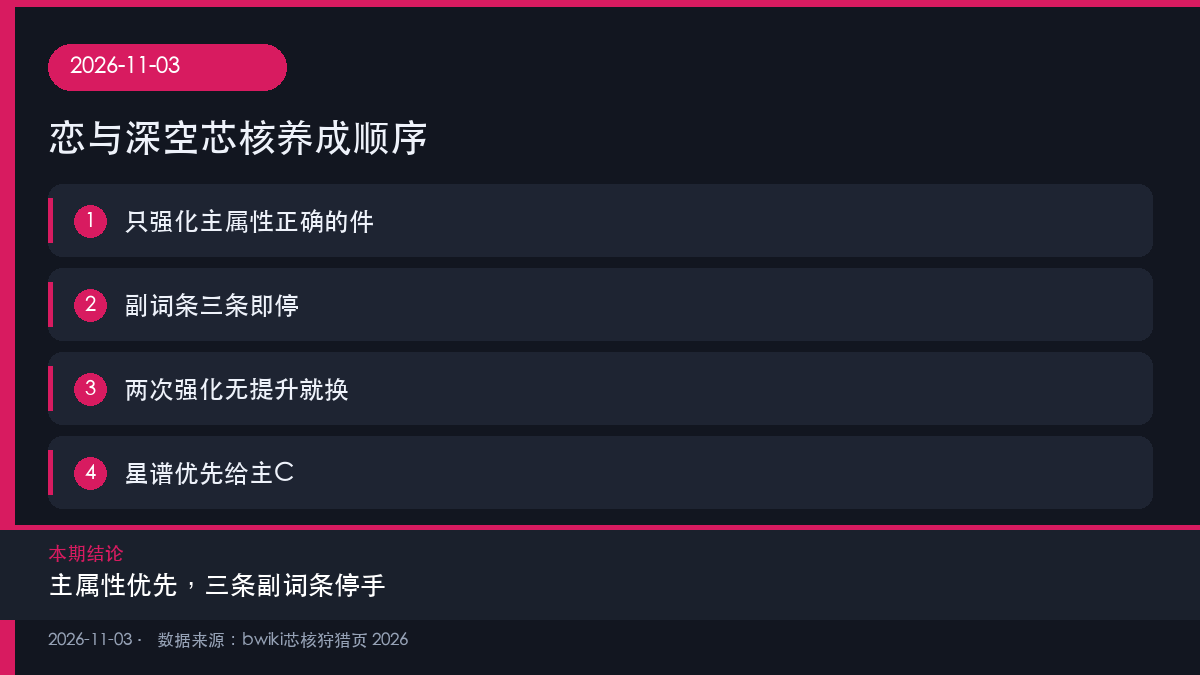
Upgrade only correct main stats
Rule one: only upgrade cores whose main stat is right. ATK or crit for the main DPS, HP or DEF for supports, and nothing else enters the queue.
Where to stop levelling
Stop transition cores partway and only max finished ones. Upgrade cost per level climbs, and transition pieces get replaced anyway.
Cut losses on bad rolls
If two upgrades pass without adding a useful substat, stop and swap the core. Do not keep rolling to chase it. That single rule saves more materials than three extra days of shard farming.
The replacement line
Replace only when the new piece has the right main stat and at least one more useful substat. Anything below that line is churn.

Love and Deepspace: How Many Gold Cores for One DPS
Start with the multiplier slots
Before chasing six pieces, finish the slots that carry damage multipliers. Two finished damage cores change clear speed more than six half-built ones, and they do it with less than half the materials. This is the single biggest shortcut in the whole system.
The probability estimate
At a 20% gold rate on stage 8, one 20-shard run returns about one gold. A full main DPS set of four to six slots therefore takes 30 to 50 runs, or 600 to 1,000 Starry Shards (source: extrapolated from bwiki drop data, not an official figure).
Monthly shard budget
Daily shard income is limited; extrapolating from pass and daily output, a month supports roughly 15 to 20 runs (source: extrapolated from in-game daily output, order of magnitude). One full gold set is therefore one to two months.
Upgrade materials, not shards, are the bottleneck
Material income per day is fixed and does not scale with shards. That means farming more does not mean building faster: the gate is materials. Concentrate upgrades on two or three finished cores rather than spreading them across six.
Which slots first
Damage and crit slots first, pure survival slots last. Damage multipliers cluster in the former, so clearing content faster brings the later materials faster.

Love and Deepspace FAQ
How many cores does one hunt give?
A: Five per stage for 20 Starry Shards; stage 8 guarantees 1 gold, 1 purple, 2 blues plus one random-quality roll (source: bwiki Core Hunt page).
Should I keep a gold core with the wrong main stat?
A: Keep it as transition gear but do not max it. A maxed wrong main stat only amplifies the wrong number.
How many substats count as done?
A: Three useful ones. The fourth is an endgame chase worth under five seconds of clear time in practice.
Can I farm a high stage underlevelled?
A: No. Stage 1 needs Hunter Level 27 and stage 7 needs 55, so push the main story and dailies first (source: bwiki Core Hunt page).
Love and Deepspace Action List
- Check today's rotating set before spending shards.
- Upgrade only cores with the correct main stat.
- Stop at three useful substats.
- Leave transition cores mid-level.
- Feed shards to the main DPS, not the supports.
Core and card data is revised in the GameHub guide section whenever the client updates.